
The wait is finally over.
Last night, almost a year to the day that we were promised four rate rises within the year, the almighty US Fed raised rates for the second time in a decade. Why, you ask? Why else but “the recovery”! The very same recovery that the American people rejected, some argue unjustifiably, with the election of Donald Trump on November 8th.
Hand in hand with last night’s rate rise was the additional indication of three more rate rises next year, again, similar to the four that were promised last year.
As we saw last year, the blowback risks to a proper rate tightening cycle are too great to do more than one hike. We mean really great, like the greatness of the size of debt that now underpins the global economy.
Since 2008 we have all known that reform is never really an option; we can only keep going until it proper breaks. No write down of bad debt, no financial market/derivative reform, just keep loading it up until it can literally take no more.
The enormity of US dollar debt that fuels the rocket under its rise over the last few months has world economic feeling swallowing an indigestible interest rate pineapple and pretending to enjoy it.
If rising rates in an over indebted global economy seems like a bad idea to you it’s probably because it is. And before we go on, if you think there’s been enough money created in the last 10 years to fix this, think again. This is JUST THE BEGINNING.
It’s like this from Macro analyst Peter Boockvar, “In last week’s Q3 Flow of Funds statement from the Fed, total US non financial debt rose to $47 trillion, up 5.8% y/o/y and higher by 9.3% from two years ago. This is 252% of GDP, a new record high.Thus, every 100 bps higher in interest rates would add $470 billion of higher interest expense per year.”
The above is just an indicator of issues and, again, surely it’s nothing that a few trillion of freshly printed won’t fix, right?
Worryingly, this may not be the biggest issue. Let’s not forget the USD10 trillion loaned internationally, especially in emerging markets. This is greater than the combined GDP’s of Japan and Germany, and every tick higher in the dollar creates even more pressure in an already stressed environment.
In particular, the Chinese Yuan is pegged to the US dollar, and China is again burning through reserves to defend it. Officially, China spent $70 billion in November alone, defending the Yuan on the back of accelerating capital outflows.
We really thought (hoped) the Fed would try and put a dampener on the USD by perhaps signaling a more cautious approach to rate rises. They didn’t, and the effect was felt immediately, particularly in Asia.
Today, China’s Bond market crashed by the highest amount on record. There’s no point showing you the chart, just wait for the blowback in equity markets.
The strong USD also hurts US corporate profits, GDP, Bonds, Mortgages and home refinancing and US manufacturing. We could go on and on- it is simply madness and we hope you’re starting to wonder why on Earth they’d do it. Right now especially, there is so much leverage on the “long US stocks, long USD can’t lose” trade. Oh, and by the way, with a rising USD, short gold too.
In our opinion, complacency in this “can’t lose” trade has reached levels we’ve only experienced in 1999 and 2007.
The S&P 500, on a longer term chart looks like this.
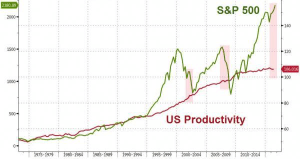
So for the US Fed, apart from being “run over” by the bond market these last few months, was this rate rise about saving some credibility? Something else, perhaps?
In Europe, the European Central Bank’s continuation of €60 billion per month (down from 80B) to attempt to stabilise bond rates, stock prices, keep general panic at bay and the Euro project together doesn’t seem to bother them too much.
The same practice is happening in Japan- there seems absolutely no limit to what their wizard behind the curtain can do (albeit despite some panic today when the Yen was falling and the Nikkei didn’t go up).
So what’s it all about, you may ask. We’re asking that too. We can say some green tea was spilt on 31A when we read the following headline a couple of weekends ago. And no, we’re not talking about Renzi singing Karaoke, we mean the headline below it.
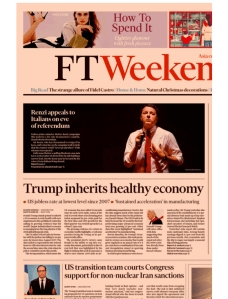
Just as the FT and friends were all Team Hillary leading up to the election, it seems now as if the real state of the US economy is to be revealed over the next coming months, and just look who they have to blame!!!!
It’s blindingly obvious what the next chapter of “how to manage a fiat currency, debt based monetary system” will look like.
By the looks of the three-way Gold/Oil/Yuan movement between Russia and China, on the back of their historic Energy deal last year, they know it too.
However, as demonstrated below, there’s a little bit of overhang, which would not stress either party out in the slightest.
It looks like the following- a gigantic, unhinged casino with fractional reserve or no collateral at all. Where the longer this goes on and the lower the price goes, the more they’ll say thanks.
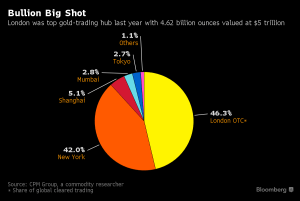
As Grant Williams subtly summarises, “what would you do if you were China/Russia in relation to energy trade;
MINIMIZE your production in order to MAXIMIZE your holdings of one of the most abundant and easily-produced commodities in the world—U.S. treasuries—as has been the case for the last 40 years… knowing full well that, with the level of entitlements due in the next decade, more will need to be printed like crazy?
Or……
Do you MAXIMIZE production in order to gain the largest possible market share in the biggest oil market in the world and, through the ability to buy gold for yuan, thereby maximize your reserves of a scarce, physical commodity which is impossible to produce from thin air and which happens to be not only the most undervalued asset on the planet, but is trading at its most undervalued relative to U.S. treasuries in living memory?”
Someone likes these prices!!
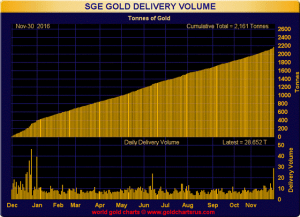
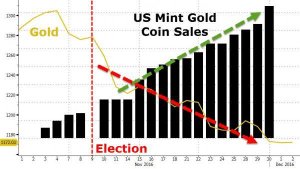
With just one month left in the year, Shanghai has withdrawn close to 2,200 tons (28 tons just this last Friday). If you take Chinese and Russian supply out of the equation as they do not export, total global production of gold is roughly 2,400 tons. Shanghai/China have been purchasing nearly all global production of gold over the past several years. This does not account for Indian demand which has historically been another 1,000 tons per year othereabouts. Nor does it account for the rest of global demand which has been brisk from Europe, the U.S. and elsewhere.
We understand the human desire to believe that this time it’s different, and in many ways it is, however, the laws of nature will always take a toll on economic mismanagement
So just remember, when in doubt:

Oh, and one more thing:
 Aurum Echo
Recent Comments